
Key Takeaways
Answer Engine Optimization (AEO) is the practice of making content visible to AI systems, Google AI Overviews, ChatGPT, Perplexity, Gemini, that generate direct answers instead of ranked lists of links. It works by combining core SEO fundamentals with signals specific to how AI models retrieve, weigh consensus, and choose what to cite.
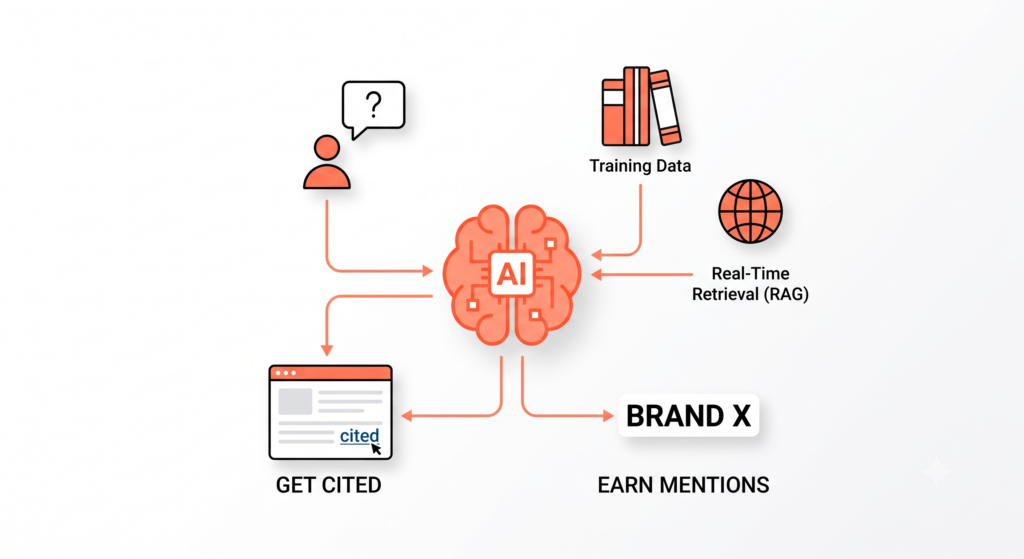
AI reads training data and live retrieval, fans one query into many, and picks who to cite based on consensus, freshness, and authority, probabilistically, not as a fixed rank.
That’s why mentions beat backlinks, why stale content underperforms, why full topic coverage beats single-keyword optimization, and why no one platform’s preferences represent the whole picture.
None of it erases SEO fundamentals or means organic search or SEO is dying. It reorganizes what they’re pointed at. A site with real authority, genuinely useful content, and a technical foundation that doesn’t accidentally block the systems trying to read it already holds most of what AI search rewards.
The field is still early enough that the data underlying parts of this guide will look dated within months, several of the studies cited here have already been updated once or twice since its first publication. That’s a reason to keep checking the numbers periodically, not a reason to wait before starting.
An AI Overview appears on your target keyword, and the CTR for the #1 organic result drops by more than half: 58% based on a comparison Ahrefs made on 300,000 keywords against Google Search Console data from December 2023 and December 2025.
Some other researchers independently found that users click through a website in just 8% of searches when an AI summary is present, versus 15% without one.
None of that means organic search or SEO is dying, as most searches never trigger an AI Overview at all, but a meaningful share of search now is resolved inside the answer, not on a page you can rank on.
This guide covers how AI search decides what to cite, how to find where your brand is invisible, and what to do about it.
What Is AEO, and Why It Matters Now
AI Search vs. Traditional Search: Competing for a mention, not a ranking position
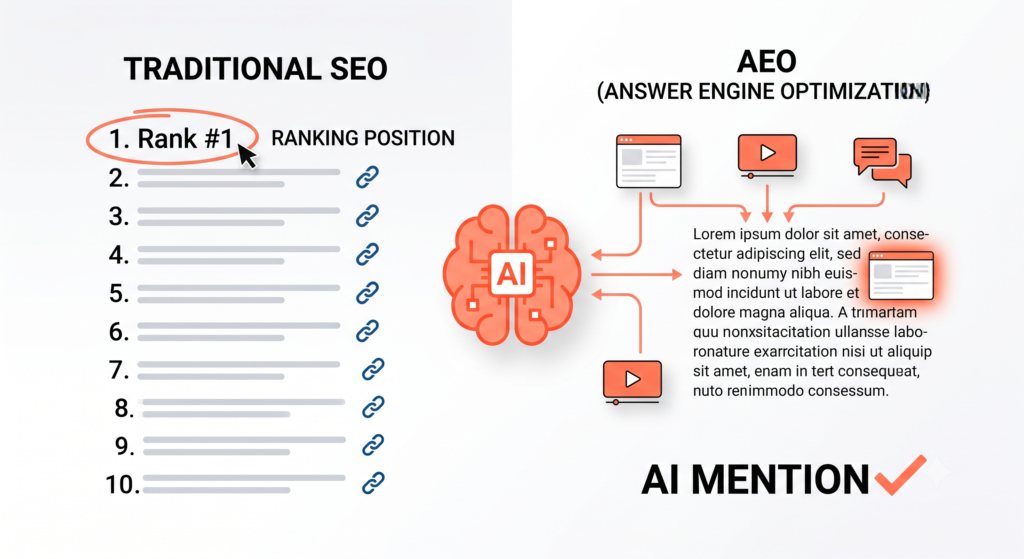
Traditional SEO is a competition for position. You optimize a page, it ranks third or first, the user sees a blue link and clicks it.
AEO (Answer Engine Optimization) works in a different way entirely. It’s a competition for a mention. The AI reads from dozens of sources, synthesizes an answer, and decides, if any, who to name. There’s no ranked list to climb, you’re fighting to be one of the sources the model chose to mention, out of everything it reads.
You’ll also see this called GEO (generative engine optimization) or LLMO (large language model optimization). Same dynamic, different acronym.
The numbers behind the shift
Four figures explain why this now matters at the level of business strategy, not just marketing trivia.
Click-through rate is collapsing on the pages that used to win
The 58% CTR drop above is corroborated by several independent research methodologies. Behavioral studies found essentially the same pattern using a completely different methodology: direct observation of real searchers rather than aggregated Search Console data.
Unrelated research approaches landing on the same conclusion is a stronger signal than any study alone.
AI Overviews are getting harder to avoid
They now cover roughly 48% of industries as of early 2026, up sharply year-on-year, with health, education, and research queries running closer to 80% coverage.
The traffic that does arrive converts unusually well
AI search drove 0.5% of its blog traffic but 12.1% of sign-ups, a 23x higher conversion rate than organic. The assumption is that when an AI recommends your brand or website, it has usually already explained to the user why you’re a good fit before they ever land on your site. The traffic arrives pre-qualified instead of browsing.
Content volume alone doesn’t buy visibility
Publishing volume alone doesn’t buy visibility. Page count correlates weakly with AI mentions (~0.19) compared with branded mentions or YouTube presence.
Hopefully this finally proves that there’s no such thing as a keyword density or minimum word count threshold needed to win on both traditional SEO and AEO/GEO.
AEO/GEO’s foundation is SEO. It doesn’t replace it
AEO/GEO isn’t an entirely new discipline. It’s basically SEO done right with some key differences connected to brand marketing, social media, and community management.
Content quality and helpfulness, real brand authority, technical accessibility, pointed at a new kind of results.
Sites built on genuine usefulness already hold most of what AI search rewards.
If your SEO was built on ranking tricks rather than solving a real problem for a real user, AEO will expose that quickly, as probabilistic citation across dozens of sources leaves nowhere to hide thin content the way a single ranking position sometimes could.
If your SEO was already built on being genuinely useful, you already hold most of what AI search rewards.
How AI Search Engines Actually Find and Cite Content
Training Data vs. Real-Time Retrieval (RAG)
AI models pull their data from two sources: training data (a snapshot updated every few months) and real-time retrieval (a live web search run per query, a.k.a as RAG- retrieval-augmented generation).
So, if you launched a product last week, the model has no idea it exists from training data alone, and it has to perform a live real-time web search to retrieve this information, pulls back a set of pages, reads them, and generates an answer grounded in what it found.
There are two ways to influence what AI says about your brand: get mentioned widely enough to eventually enter training data, or rank and structure content well enough to surface in retrieval right now.
Both routes run through recognizable SEO work, earning genuine coverage, and being technically and editorially good enough to surface in search. Proving that good SEO work is the foundation of AI Search.
Query Fan-Out: One Prompt Becomes Dozens of Sub-Queries
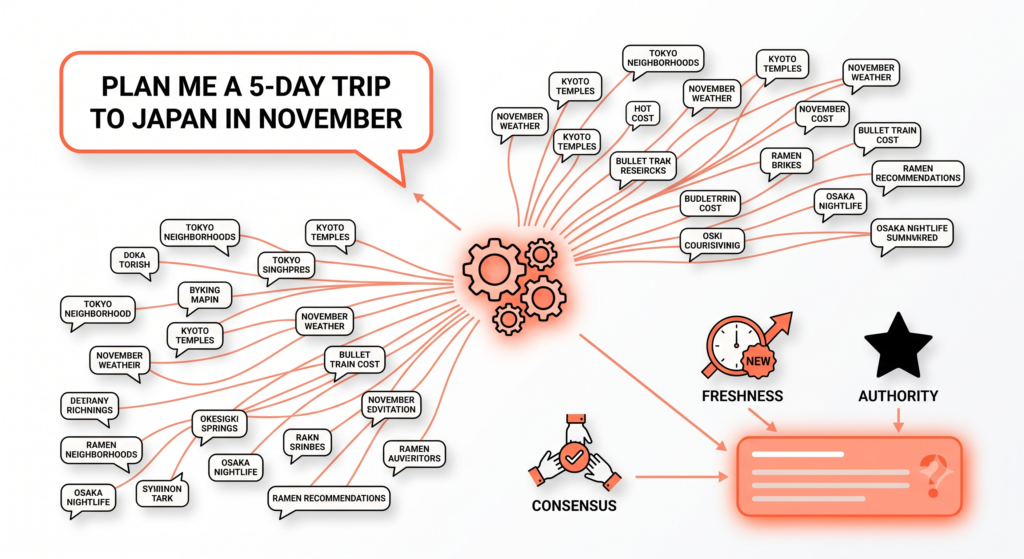
Query fan-out is the mechanism that changes what “optimizing a page” means. One prompt expands into many sub-queries behind the scenes. The average prompt triggers 9 to 11 fan-out queries, some as high as 28.
So, for example, a prompt like “plan me a 5-day trip to Japan in November” fans out into dozens of smaller sub-queries running behind the scenes: “best neighborhoods in Tokyo”, “November weather in Kyoto”, whether the “Japan Rail Pass is worth it” or not, each one searched independently before the model merges everything into a single answer.
A page that covers a topic completely beats a page optimized for one keyword, since the AI is actively searching for whatever a thin page left out. A page about how to start a podcast that skips equipment, hosting, or promotion will lose out to a competing page that covers the whole topic.
Fan-out depth isn’t random. It scales with how ambiguous the original prompt is: a vague query forces the model to search more broadly to disambiguate what the person actually wants, while a tightly scoped query needs fewer sub-searches to resolve.
In one documented case, ChatGPT’s deep research mode ran roughly 200 separate searches just to hedge across possible phone models and case styles for a single query about buying a red phone case.
Separately, Seer Interactive’s own analysis of Gemini 3 found that pages ranking for a topic’s fan-out queries were 161% more likely to also get cited in the resulting AI Overview, evidence that fan-out visibility is a real lever.
Why AI citations are probabilistic, not fixed rankings
In traditional search, if you rank #3 for a keyword today, you’ll likely rank somewhere near there tomorrow. AI citations don’t behave like that. Ask the same question five times and get five different cited brands.
A given AI Overview has roughly a 70% chance of showing meaningfully different content between observations, even for the same query. The goal shifts from “rank #1” to “raise the odds of inclusion.”
3 factors raise those odds: consensus (multiple sources agreeing on a claim), freshness (AI-cited content runs meaningfully newer than standard organic results), and authority.
Though authority’s role is shrinking fast, as 76% of AI Overview citations used to come from Google’s top 10 results, a follow-up 8 months later found that it had fallen to 38%. Ranking well still helps, but it’s no longer sufficient alone.
Why Every AI Platform Plays by Different Rules
Google AI Overviews vs. AI Mode vs. ChatGPT vs. Perplexity
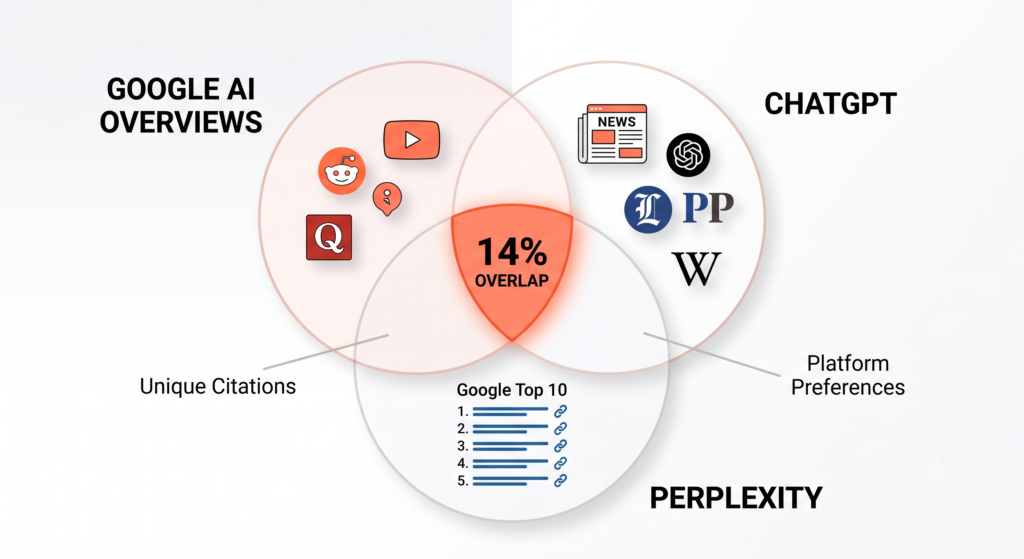
Each AI platform cites a different slice of the web. Looking at the top 50 most-cited domains across Google AI Overviews, ChatGPT, and Perplexity combined, only 7 appear in all three, a 14% overlap. Optimize for one platform, and you’re likely optimizing for something close to 86% irrelevance elsewhere.
- AI Overviews favor YouTube, Reddit, and Quora, none of which crack ChatGPT’s top 10.
- ChatGPT leans on Wikipedia, news outlets, and publisher content, with licensing deals behind some of it, and 67% of its top 1,000 citations come from sources you can’t influence at all. That share drops sharply for commercial-intent queries specifically.
- Perplexity is the most SEO-aligned platform, 28.6% of its citations come from Google’s top 10, versus roughly 8-10% for the others.
- AI Mode, despite being a Google product like AI Overviews, shares only 13.7% citation overlap with it, despite 86% semantic similarity in the actual answers.
Prioritize being present where the traffic is (Google and ChatGPT dominate combined volume) and where your existing strengths already overlap with what a given platform rewards, not by picking the biggest platform by default.
The Three Types of AI Visibility
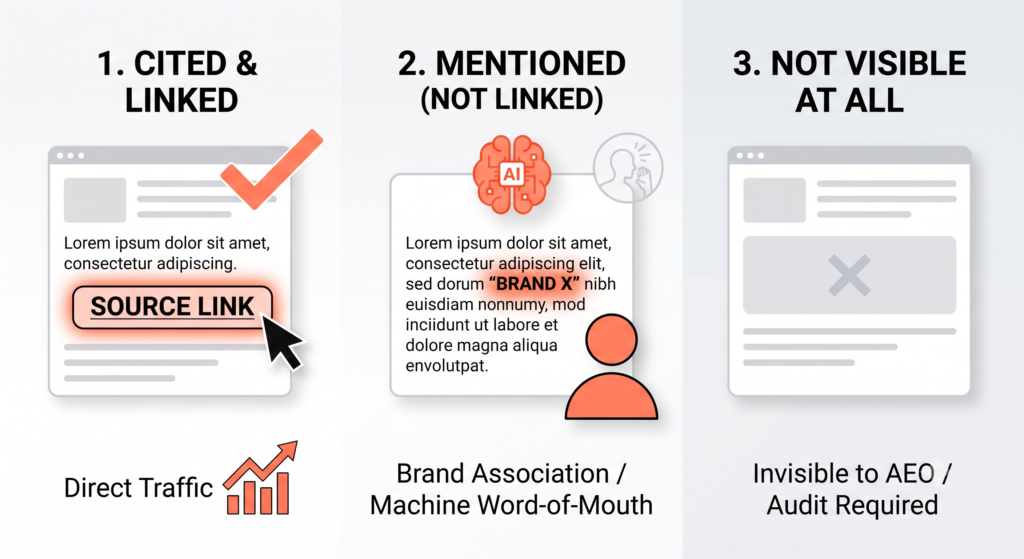
Cited and Linked, Mentioned But Not Linked, Not Visible at All
“AI visibility” isn’t one thing, and treating it as one thing leads to the wrong conclusions about whether your AEO/GEO work is paying off. There are three distinct outcomes when an AI system encounters your brand while generating an answer.
Cited and linked (easiest to measure, only outcome producing direct traffic), mentioned but not linked (far more common than assumed, functions as word-of-mouth at scale), and not visible at all (the state you can’t see without actively auditing for it).
- Cited and linked is the outcome most people want: the AI names your brand and includes a clickable link to your page in its sources. This is the easiest outcome to measure and the only one that produces direct, attributable traffic.
- Mentioned but not linked is far more common than most people expect. The AI names your brand in its answer, but gives the user nothing to click. You get no direct traffic from that specific response, but the user now has your name. If they’re interested, the natural next step is searching for you directly, functionally a word-of-mouth recommendation happening at machine scale.
- Not visible at all means the AI answers the question without mentioning you in any form. This is the easiest state to miss, because there’s no data point marking its absence, no traffic dip to notice, no mention to track. You only find it by actively auditing the topics and prompts where you should be showing up and aren’t.
Why only 28% of AI mentions include a link
Most people assume that when an AI mentions a brand, it’s citing a link too, but it usually isn’t. Only ~28% of AI mentions include a link on average, and it varies sharply by platform: 10.7% on AI Overviews up to 51.6% on Perplexity.
| Platform | Mentions that include a link |
|---|---|
| AI Overviews | 10.7% |
| Gemini | 16.8% |
| Copilot | 26.1% |
| ChatGPT | 26.9% |
| AI Mode | 36.8% |
| Perplexity | 51.6% |
If your visibility tracking leans heavily on AI Overviews specifically, expect roughly 9 out of 10 brand mentions to arrive with nothing clickable attached at all.
Why unlinked mentions still matter
None of this makes the other 72% of mentions worthless. Unlinked mentions still matter, the mechanism is training, not traffic.
Every time a language model reads your brand name associated with a specific topic across a credible source, that’s another data point reinforcing the association, the same way repeated exposure teaches a person to think “electric cars” when they hear “Tesla.”
Even without a link, being mentioned consistently builds the underlying association the model draws on later. It’s a slower payoff than a click, but it compounds.
Not every AI response is shaped the same way either, and the format changes what kind of visibility is even possible.
Step-by-step guide responses (“how to fix a leaky faucet”, “how to set up Google Analytics”) create an opening to be recommended as the expert source, which is valuable if you’re a service business or how-to publisher.
Direct factual answers (“what’s the capital of France”) rarely produce a click, since the AI resolves the question itself, but repeated citation on these builds durable topical authority, which is what you’d want to build for your brand.
Finding Your Brand’s AI Visibility Gaps
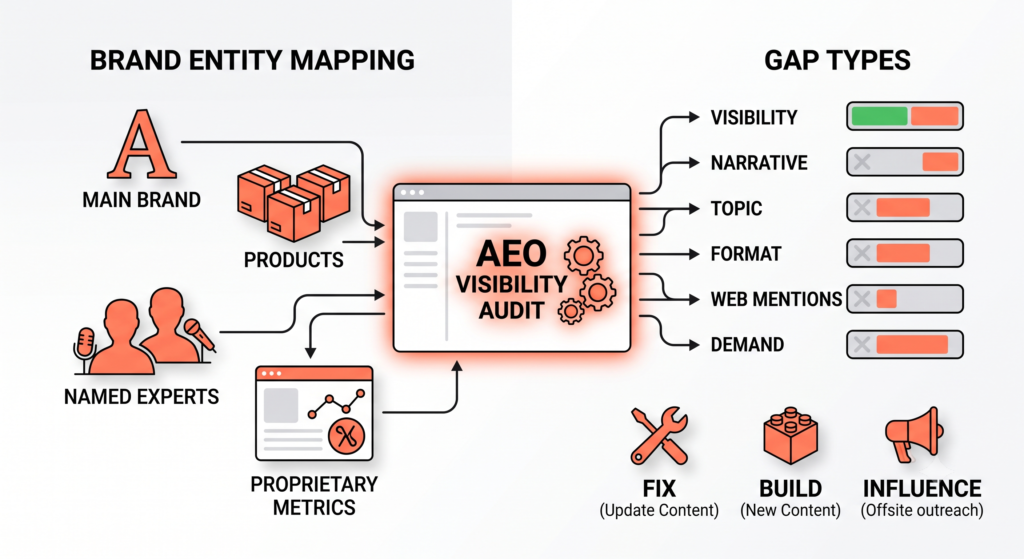
Mapping your branded entities
Map your branded entities first: main brand, sub-brands, products, proprietary metrics, named experts; each carries its own visibility profile and deserves its own check.
Before measuring anything, get specific about what you’re actually measuring. A brand rarely gets referred to just one way.
Map out your main brand name, any sub-brands, product names, proprietary features or metrics, and personal brands tied closely to the company (founders, named experts, spokespeople).
Each of these carries its own visibility profile in AI answers and deserves its own check, not one blended number that hides which specific entity is or isn’t showing up.
Once you have the list, connect each entity to the topics and qualities it should be associated with. Neither search engines nor language models understand a brand name in isolation, they infer meaning from how it’s described across the web.
A quick way to build this list is standard keyword research: look for the adjectives, modifiers, and descriptive phrases that already cluster around your “brand/niche”, “affordable”, “enterprise-grade”, “AI-powered”, whatever applies.
That list becomes your benchmark for what your brand should be known for once you start auditing what it’s actually known for.
Running the Audit: Tools and What to Check
Ahrefs’ Brand Radar is one option for this, but it isn’t the only credible tool doing this job.
Semrush’s AI Visibility Index, Profound, and Peec AI all track brand mentions and citations across AI platforms with broadly comparable methodology.
Pick your preferred tool based on which platforms you need covered and what you’re already paying for elsewhere, the underlying audit logic applies regardless of tool.
Whichever tool you use, four numbers matter to pull from any AI visibility tool: mentions (how often your brand is named in AI responses), citations (how often your website is actually linked as a source), impressions (an estimate of how many people saw a response that included you), and share of voice (how you’re named relative to competitors for the same queries).
The six gap types: visibility (you appear less than competitors), narrative (AI describes you wrong), topic (missing associations), format (competitors own a content type you don’t), web mentions (third parties mention them, not you), and demand (branded awareness gaps).
Once you have the raw numbers, sort what you find into six categories. This framework gives a better picture than any single metric on its own:
- Visibility gap: Your brand appears less often than competitors across search or AI results for the same queries.
- Narrative gap: How AI or media currently describes your brand doesn’t match how you want to be positioned, for example, being called a budget option when you’re positioned as premium.
- Topic gap: Topics you should be associated with but currently aren’t. A project management tool never mentioned when people ask about remote team collaboration is a topic gap.
- Format gap: AI disproportionately cites certain formats, guides, comparison pages, video, and if competitors have that format covered and you don’t, that’s a gap.
- Web mentions gap: Third-party sources, listicles, review sites, forums, publications that mention competitors but not you.
- Demand gap: Branded queries or searches signaling awareness opportunities you haven’t captured, people searching in your category without your brand name ever coming up alongside those searches.
Prioritize by fix (update existing content), build (net-new for uncovered gaps), or influence (earned mentions).
You’ll face more gaps than you can close at once, so you need to prioritize.
Most fixes fall into one of three buckets:
- fix (improve something that already exists, a page that ranks but needs a content update to close a topic gap);
- build (create new content for a gap you’re not covering at all);
- influence (offsite outreach and mention-building, closing a web mentions gap through earned coverage rather than owned content).
Weigh each against 3 questions: how much demand would closing it drive? Does it support the positioning you actually want? Does it plausibly raise your odds of being cited?.
Start with the quick-wins (lowest-effort, highest-likelihood of win). An existing page needing a freshness update beats a net-new content project almost every time.
Pro tip: run this exact same audit on your closest competitors. Their branded queries and topic associations often surface gaps in your own coverage that wouldn’t have been obvious from auditing your own brand alone.
Keyword and Prompt Research for AEO/GEO
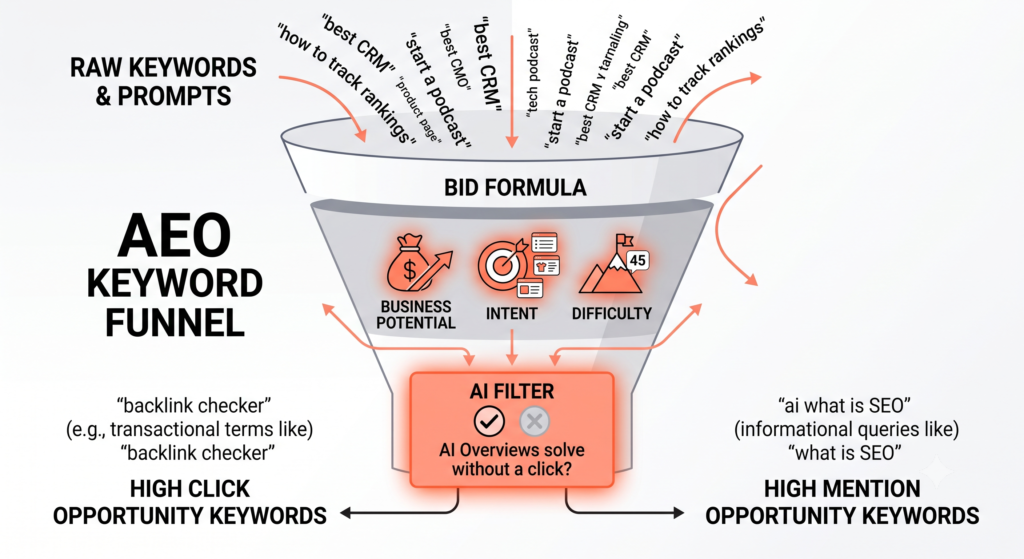
Building the keyword list
The starting mechanics from traditional SEO keyword research haven’t changed much. You still need seed keywords, broad terms describing your niche, and modifiers, add-ons like “best” or “how to” that turn a seed into something people actually type.
You can use your SEO tool of preference (Ahrefs, SEMrush, Sitrix, etc) to identify seed keywords from your niche and then discover modifiers for your specific business model and audience.
From your seed keyword, you can ask an AI assistant like Claude, ChatGPT, or Gemini to suggest similar relevant terms and query fan-out outputs to give you even more options.
I like to use tools like AlsoAsked to find those long-tail queries from a seed keyword as well.
Then you can cross-check this whole list in your SEO tool to validate average search volume.
The query fan-out and long-tail keywords usually return 0 or a very low search volume, as most of them trigger the well-known “zero-click searches” and SEO tools can’t often get any search volume for it. That doesn’t mean they should be ignored and/or not optimized for.
The BID Formula: Filtering for keywords worth targeting
Not every keyword with a healthy volume-to-difficulty ratio is worth the effort, and a 3-part check catches most of the traps before you commit resources.
Filter through the BID formula: business potential (would ranking actually help), intent (does the SERP match your planned format), difficulty (can you realistically compete). Don’t get trapped on legacy vanity metrics.
- Business potential: would ranking #1 actually move the business, or does the searcher have no real intent to act? “What is espresso” gets real volume and low difficulty, but almost nobody searching it is about to buy anything.
- Intent: check what’s actually ranking for the keyword today. If every top result is a product page and you’re planning a blog post, the SERP is telling you the format is wrong before you write a word.
- Difficulty: check the referring domains and authority of what’s currently ranking. A page with a realistic shot at ranking beats one that’s technically relevant but structurally outmatched.
The AI Filter: When a keyword isn’t worth targeting for clicks
Passing the BID formula isn’t the end of the filter. There’s a 4th question specific to AI search: can an AI Overview or AI answer fully satisfy this query without anyone needing to click through? If the answer is yes, ranking #1 might get you an impression and nothing else.
Ahrefs analyzed 146 million SERPs and found AI Overviews appear on 20.5% of all keywords overall, but 57.9% of question-format queries and 46.4% of queries with 7+ words, almost entirely informational intent. Single-word queries trigger an AI Overview just 9.5% of the time.
99.9% of keywords that trigger an AI Overview fall into informational or “Know” intent, while commercial and transactional keywords trigger one only about 10% of the time.
Tool and calculator queries (“backlink checker”, “mortgage calculator”, etc.) largely resist AI Overviews entirely, since the AI can’t perform the action itself, the real click opportunity remains there. Filtering a keyword tool for these modifiers, or filtering directly by transactional intent, surfaces a pocket of search demand where the organic click is still fully available.
Informational queries are exactly where you’re most likely to be competing with Google’s own AI-generated answer instead of the traditional 10-blue links. Before committing to a keyword, search it and honestly assess whether the AI Overview already resolves the question. If it does, that keyword still has value, just not as a click-through target.
Finding AI Mention opportunities
For keywords where an AI Overview does satisfy the query, the goal shifts from earning a click to earning a mention inside the answer itself. Understanding what AI actually cites for these queries matters.
“Best X” listicles make up 43.8% of what ChatGPT cites at the top of the funnel. However, Lily Ray’s article argues that recent Google search updates are reducing the visibility of B2B, SaaS, and affiliate websites publishing self-promotional listicles, particularly articles titled “Best [Category] Tools” where the host company automatically ranks itself first.
The primary driver of these drops is not an explicit penalty against self-ranking lists, but rather Google’s improved quality classifiers targeting thin, templated content, unhelpful affiliate bias, and scaled AI-generated pages that lack authentic user experience and clear testing criteria.
So, should you publish your own “best X” list and rank yourself first? Yes and no, it depends on how you do it.
Publishing a “best X” list and ranking yourself first has a high-risk of ending up falling under the “it works until it doesn’t” premise, because Google’s review systems actively penalize content with obvious commercial bias.
Instead of claiming a blanket #1 spot, publish transparent alternative or competitor comparison pages with clear evaluation criteria, and/or focus on getting featured on reputable third-party review platforms.
Publish content that is genuinely useful to users navigating a competitive category/industry and help them make their decision.
Prompt Research: A different kind of search behavior
Keyword research assumes people type roughly similar phrases for the same intent. Prompt research doesn’t make that assumption.
Someone opening ChatGPT or Perplexity writes in full natural language and full context, “I’m a small agency owner looking for a marketing platform, which one should I choose?” and “what’s the best way to track rankings if I’m just starting out?” can both be asking essentially the same underlying question with zero word overlap.
Combined with the query fan-out behavior, where each of those prompts silently expands into 9 or more sub-queries behind the scenes, chasing individual prompt phrasing is a losing and outdated strategy.
The practical approach is to build visibility across the whole topic a prompt sits within, not optimizing for any single way of asking it.
Creating content that gets cited
What the Data Says: Word Count, Freshness, Format
Three data points should shape how you write before any style guide does.
Word count barely matters
A Spearman correlation of 0.04 across 174,048 cited pages, essentially zero; 53.4% of cited pages run under 1,000 words.
If you’ve been stretching posts to hit a target word count because longer supposedly ranks better, that instinct doesn’t transfer to AI citation.
Freshness matters a great deal, and unevenly across platforms
AI-cited content runs 25.7% fresher than organic results on average, but Google’s AI Overviews are the outlier, citing content slightly older than standard organic, behaving more like traditional search than the other platforms.
If your content strategy targets ChatGPT visibility specifically, freshness matters more than almost anywhere else. If AI Overviews are your priority, standard SEO freshness practices already largely apply.
My recommendation is: keep your content as fresh as possible, whenever it makes sense. Don’t update your content just because or for the sake of having “fresh content” if it doesn’t make sense.
If you have time-sensitive information within your content, make sure to keep this data up-to-date so you remain a trustworthy source of information about that topic.
Format shapes odds more than most on-page tactics
Listicles and comparison content dominate AI citations. Data-driven content built around original statistics also performs well, for the straightforward reason that AI systems need specific, attributable numbers to cite, and X-versus-Y comparison content maps directly onto how people phrase AI prompts.
4 Writing Principles That Serve Both Readers and AI
A common misconception is that AI-optimized content requires some special new format. It doesn’t. LLMs are trained on what humans already find valuable, so content that genuinely serves a human reader is content the model wants to cite. There are 4 principles that overlap:
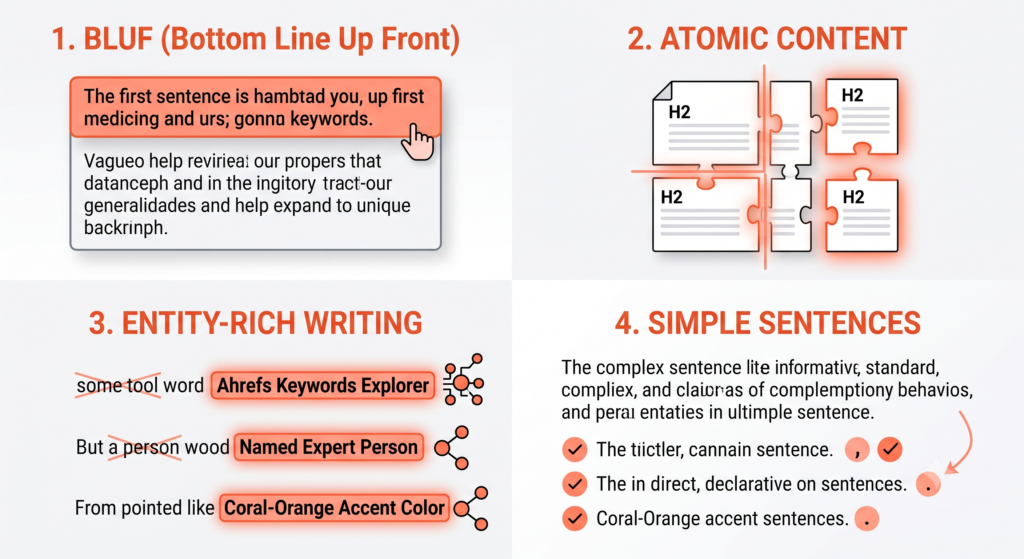
BLUF (answer first, backstory after, since both human scanning and model attention weight section openings heavily), atomic content (every section must stand alone, since AI chunks unpredictably), entity-rich writing (name specific brands, products, concepts instead of vague nouns), and simple, declarative sentences (one idea each).
BLUF (bottom line up front)
Open every section with the answer, not the runway leading to it.
Compare “over the past few years, link-building strategies have evolved significantly due to changes in how search engines evaluate link quality” against “the most effective way to build backlinks in 2026 is original research.”
The second version front-loads the claim. This matters structurally, not just stylistically: human readers scan in an F-pattern, weighting the start of a section heavily and skimming the middle, and language models show a comparable weighting pattern toward the beginning and end of a passage.
Bury the key point three sentences deep, and both audiences will miss it.
Atomic content
Every section should make complete sense pulled entirely out of context, because that’s functionally what happens when an AI system chunks your page for retrieval.
Different models chunk differently, and you have no control over where the boundaries fall, so the only reliable fix is making every section self-sufficient.
A fast test: take any H2 section, read it with zero surrounding context, and check whether it still holds together. If it depends on something explained three paragraphs earlier, it needs rewriting.
Entity-rich writing
AI systems parse meaning through named entities and the relationships between them, brands, products, people, places, specific concepts, not vague nouns.
“This tool helps with SEO” gives a model almost nothing to work with. “Ahrefs Keywords Explorer helps you find keywords with low difficulty and high traffic potential” gives it a concrete entity, a named capability, and a relationship between them.
The more specific and concrete a claim, the more useful it is when a model is trying to answer a specific question.
Simple, declarative sentences
One idea per sentence, straightforward subject-verb-object construction. This isn’t about writing down to your audience, it’s about parseability.
A sentence that takes two reads to untangle is a sentence a model is more likely to misread or skip entirely when extracting a claim.
None of this requires writing differently for AI, content that genuinely serves human readers is what models are trained to value.
Name original frameworks after your brand explicitly. Models tend to flatten uncredited ideas into generic knowledge otherwise.
And prioritize refreshing “sleeper/forgotten pages”, well-linked pages that have quietly declined, over new content: freshness is one of the more reliable citation signals, and these already carry the authority a new page would need to build from scratch.
Earning Mentions and Citations Off-Site
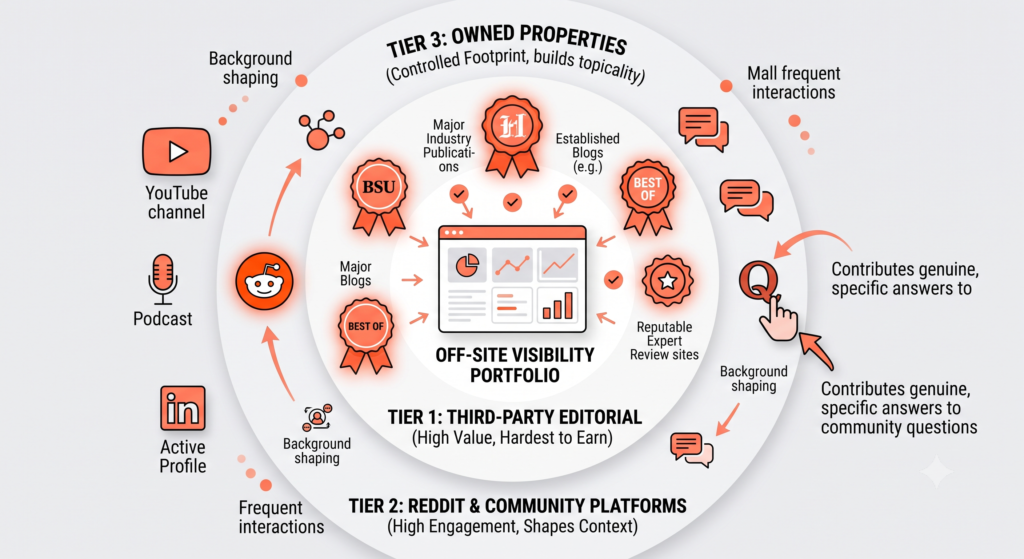
Having great content is just half of the equation. The other half is showing up on other people’s pages, specifically the pages AI systems already pull data from when answering questions in your niche.
At this point, we already know why this matters. What’s missing is where to focus outreach and content-earning effort.
Here we have it organized into 3 tiers by how hard each is to earn and how much it tends to pay off.
Tier 1: Third-Party Editorial Content
The hardest mentions to earn are also the most valuable: industry publications, review sites, comparison posts on established blogs, and YouTube reviews from creators in your space.
These matter because they’re exactly the content type AI systems already lean on. The hardest to earn, the more valuable it is.
First, look at which domains are already being cited for topics related to your brand, whichever visibility tool you’re using should surface this directly.
Second, you don’t need to wait for a page to already be cited before pursuing it.
Target pages that already carry strong authority and cover your topic, even if AI hasn’t started citing them yet.
A well-linked “best X” or comparison post that doesn’t mention you yet is a reasonable bet that it will be cited eventually, and getting included before that happens is far easier than trying to get added to a page AI is already actively pulling information from.
Tier 2: Reddit, Quora, and Community Platforms
Reddit is the single most-cited domain in ChatGPT by a wide margin, backed by a real OpenAI data-licensing deal. Well ahead of Wikipedia in second place.
Worth noting that Reddit pages get retrieved as background context far more often than they get visibly cited, meaning Reddit likely shapes answers invisibly more than it generates attributable citations.
Contribute genuine answers to real questions. Don’t drop brand names randomly into unrelated threads. Find threads where someone is genuinely asking a question your product or expertise answers well, and contribute a real, specific answer, the same way you’d apply to any community you actually wanted to be welcome in.
And most importantly, don’t spam the forum by over-self-promoting your brand there. The Reddit community is well-known for hating this behavior.
Tier 3, owned properties
Some brands operate multiple domains that carry independent authority, and each one functions as an additional citation source in its own right.
Most businesses don’t have the resources to run several separate sites, but the underlying principle still applies to a single brand’s full footprint: a YouTube channel, a podcast, an active LinkedIn presence, all of these are indexed and can all surface as sources an AI system pulls from.
Every credible, topically relevant place your brand shows up is one more data point available for a model to learn the association from.
Auditing mentions for accuracy
Audit mentions regularly. Earning a mention isn’t the end of the work, because mentions aren’t permanent. Pages get updated, “best of” lists get refreshed, and your brand can quietly disappear from a source without any notification.
AI systems can also pick up and repeat wrong information about your brand from outdated or simply wrong third-party sources.
If you find inaccurate information circulating, the fastest fix is publishing a clear correction on your own site first, then following up with the third-party publisher directly.
The faster an inaccuracy gets corrected at the source, the less time it has to work its way into how models describe you by default.
The Technical Side of AEO
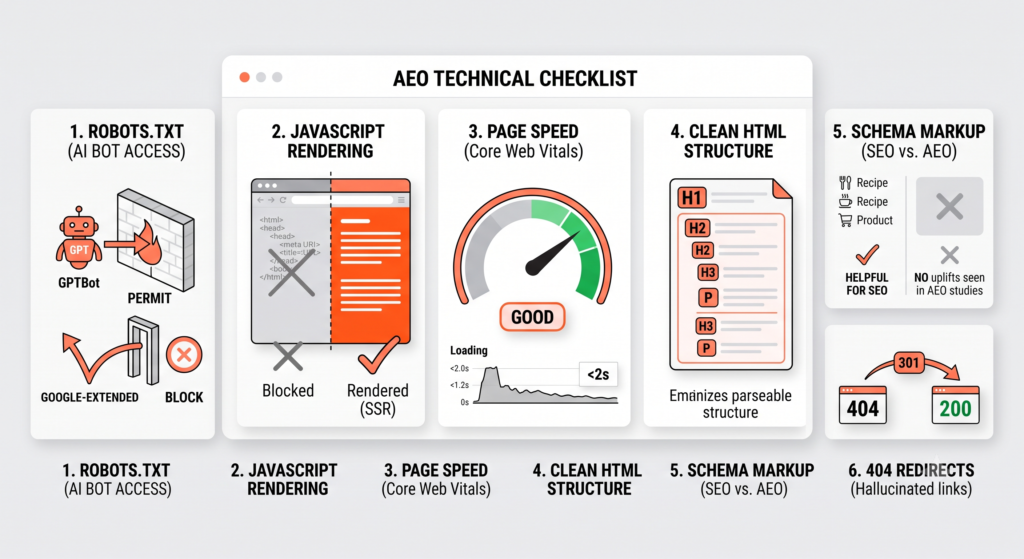
None of the content and mention strategy matters if AI systems can’t actually access and parse your site in the first place. You don’t need to rewrite your entire codebase, but there are 6 checks that determine whether AI can find you before it can ever recommend you.
Robots.txt
Block GPTBot, OAI-SearchBot, ClaudeBot, or Google-Extended, and you’ve opted that platform out entirely, often unintentionally (eg: Cloudflare’s AI-bot-blocking by default).
The llms.txt file is a proposed standard, structurally similar to robots.txt, meant to give AI systems a curated summary of a site and its most important content. It sounds useful in theory. In practice, there’s essentially no AI bot traffic reading these files at all right now.
It won’t hurt to create one, but robots.txt remains the file that actually matters for AI access today.
JavaScript rendering and Server-side rendering
ChatGPT’s crawler generally can’t render client-side JS; Gemini and Copilot generally can. Server-side rendering fixes everything.
A quick self-test: disable JavaScript in your browser and load your own site. If the content vanishes, that’s a real problem for AI crawlers.
Page Speed as a Retrieval-Time Factor
Page speed sounds like a pure SEO concern, but it plays a distinct role in AI retrieval specifically. A slow page can get dropped before it’s even scored.
If your Core Web Vitals are already in good shape for standard SEO, you’re most of the way there for this too.
Clean HTML structure
AI systems parse content by following HTML structure, so logical headings, well-organized sections, and paragraphs focused on a single idea directly determine how easily a model can extract the right information.
Use a proper heading hierarchy: one H1, clear H2s for main sections, H3s for subsections, and write every section to survive being pulled out of context, since a model may chunk your page at any heading boundary without warning.
Schema Markup: Does It Actually Help?
The honest answer? Not really! Several studies show that adding schema produces no meaningful citation uplift on any platform. Does that mean you should completely overlook it? Absolutely not!
There’s no denying how helpful Schema Markup is for traditional SEO. And, as I often say, our job as SEOs is not to hack the Search Engine but instead to make their life easier to find what they’re looking for on our website.
So, if you’re already using schema for standard SEO purposes, there’s no reason to remove it, just keep doing it as your standard practice, but don’t expect any uplift in your AI Visibility performance because of that.
It isn’t worth treating it as an AEO priority, and any claim that it reliably boosts AI citations isn’t currently supported by the best available data right now.
Fixing AI-Hallucinated URLs
AI assistants sometimes recommend URLs that don’t exist, plausible-looking paths invented from pattern-matching a site’s structure rather than pulled from an actual page.
AI assistants send visitors to 404 pages at 2.87 times the rate Google Search does. Rather than treating a hallucinated-URL visitor as a lost cause, check your analytics for AI-referred traffic landing on 404s, and where you see a consistent pattern, set up a 301 redirect to the closest relevant page. It won’t recover every visit, but it will capture traffic that would otherwise dead-end entirely.
Measuring AI Visibility
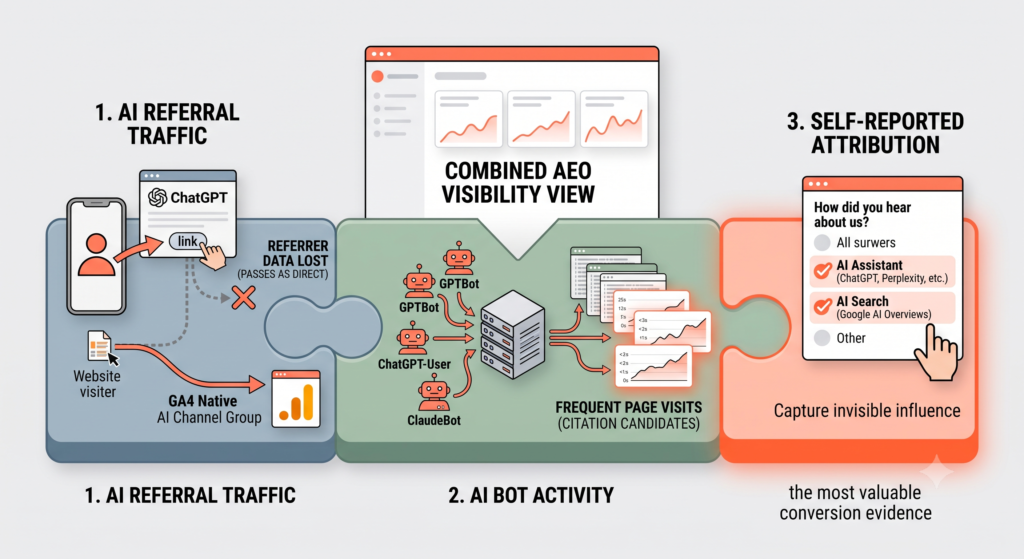
Measuring AI visibility is much harder than measuring traditional SEO results. Google Search Console gives clean impressions, clicks, and rankings. Analytics gives you sessions, users, etc. AI search mostly doesn’t hand you equivalent data.
That doesn’t mean you’re flying blind, it means you need three separate tracking approaches working together, since no single one gives a complete picture.
Tracking AI Referral Traffic (and Its Blind Spots)
The first and most obvious signal is referral traffic: someone clicks a link inside ChatGPT, Perplexity, Claude, or another platform and lands on your site. The complication is that referral data isn’t reliably passed as a large share of AI-driven visits arrive with no referrer and default to “Direct”.
GA4 added a native “AI Assistant” channel group in May 2026 covering ChatGPT, Gemini, and Claude automatically, though it still misses Perplexity. Meaning that you still need to create a custom regex channel grouping for full coverage.
Tracking AI Bot Activity
This is a different signal entirely: not the humans clicking through, but the crawlers themselves visiting to read your content.
AI bots visit at meaningfully higher volume than human traffic on most sites, and the pages they focus on repeatedly are a reasonable proxy for which pages are functioning as citation candidates.
Bot activity tip: track which AI crawlers (training bots like GPTBot vs. citation bots like ChatGPT-User) visit which pages and how often, via server logs or your SEO tool of preference.
Self-Reported Attribution
The simplest and most overlooked data source to set up, and possibly the most important for proving AEO’s value internally.
A large share of AI’s real influence never shows up correctly in analytics at all: someone gets a recommendation from ChatGPT, then opens a new tab and types your brand name directly (shows up as Direct), or Googles your brand name after hearing about you from an AI answer (shows up as Organic Search).
The only reliable way to capture this is asking them directly. Add a “How did you hear about us?” question to your sign-up flow, checkout, or post-booking survey, with explicit options like “AI assistant (ChatGPT, Perplexity, etc.)” and “AI search (Google AI Overviews)” alongside your usual choices.
None of the three alone tells the full story. Combined, they show what AI sends you, what it’s reading, and what’s actually converting.
Is AEO/GEO Actually Worth the Investment?
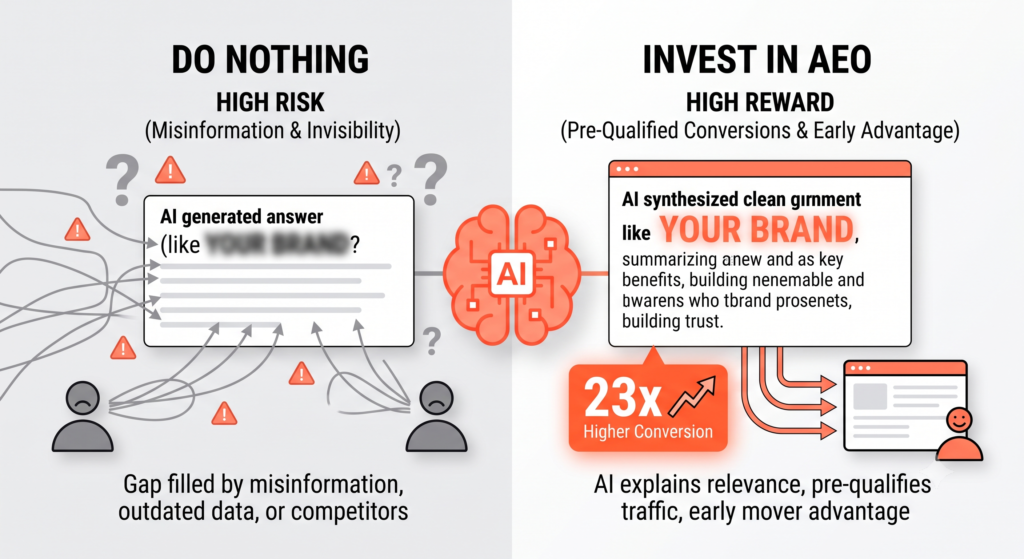
The Traffic-vs-Conversion Tradeoff
Looking at raw traffic alone, AI search still looks small next to Google. AI referral traffic remains a tiny single-digit percentage of most sites total traffic.
If you look at it purely on volume, it would be reasonable to deprioritize it. But volume isn’t the metric that settles this, conversion quality is, and the pattern here is consistent across genuinely independent sources rather than a single vendor’s convenient number.
Conversion quality from AI traffic isn’t a fixed constant, it’s been improving as the platforms mature and the traffic composition shifts, which is worth knowing before treating any single conversion multiplier as permanent.
By the time someone clicks through from an AI answer, the model has typically already done the comparison shopping and explained why you’re relevant. The traffic arrives pre-qualified rather than browsing.
Beyond clickable traffic entirely, there’s a harder-to-measure but real layer of impact. Every AI recommendation is an impression that didn’t exist before, and most of those impressions never produce a click at all. They produce a later branded Google search or a moment of recognition on social media instead.
That’s genuinely difficult to attribute cleanly, the same way a billboard in a busy street is difficult to attribute cleanly, but something difficult to measure isn’t evidence that it isn’t working.
The Misinformation Risk
Before deciding whether an AEO/GEO investment is worthwhile or not, know that doing nothing doesn’t mean AI says nothing about your brand.
It means that whatever the web already says about you, accurate or not, is what fills that gap by default.
Filling this gap with your own specific, detailed, official information is a defensive AEO investment as much as an offensive one.
The advantage right now belongs to whoever starts building the visibility layer while most competitors still haven’t begun.