SEO, GEO, and AEO aren’t three competing strategies. They’re three targets, aimed at three different places your content can show up.
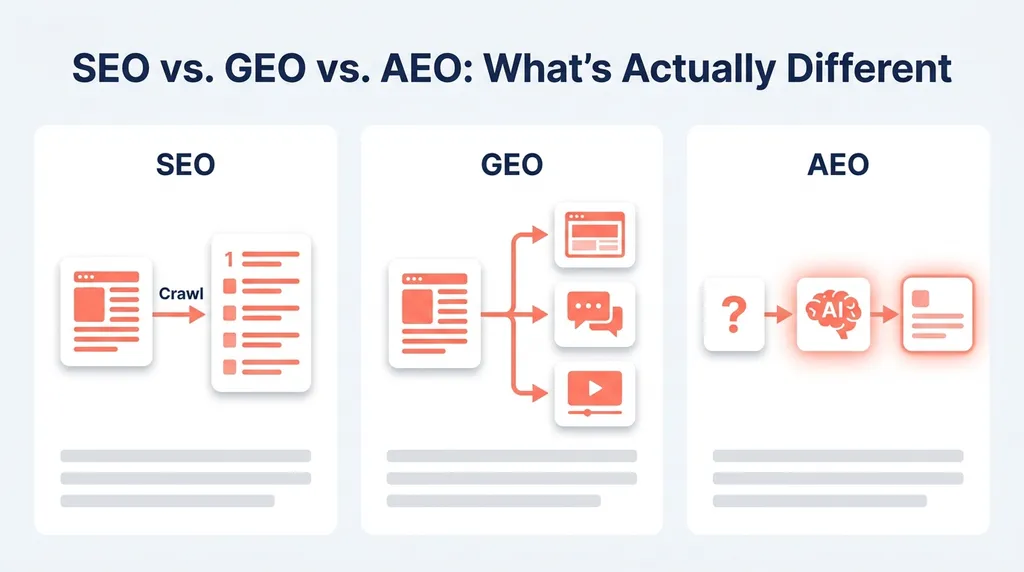
SEO optimizes for ranking: getting a URL onto page one so someone clicks it. GEO optimizes for representation: getting your brand and content understood and reused correctly across generative AI systems, as a whole. AEO is a specific tactic inside GEO: optimizing a piece of content to be the exact answer an AI system selects and cites for a given question.
None of them replace the others, and none of them replace good SEO fundamentals. Authority, technical accessibility, and genuinely useful content are the foundation all three sit on.
For most sites, the honest answer to “which one do I need” is: you’re already doing SEO, GEO is the lens you view it through now, and AEO is one tactic you apply within that lens. You don’t pick one.
Three acronyms, one confusing few months for anyone trying to keep up with search. SEO, GEO, and AEO get used interchangeably in headlines and swapped mid-article, which is a problem if you’re trying to figure out where to actually spend your time.
Here’s the breakdown, without the hype.
The quick answer
- SEO (Search Engine Optimization): getting a page to rank in traditional search results, so a person clicks through to your site.
- GEO (Generative Engine Optimization): optimizing your content and brand presence so generative AI systems retrieve, summarize, and represent you accurately, whether or not anyone ever clicks through.
- AEO (Answer Engine Optimization): optimizing a specific piece of content to be selected as the direct answer an AI system cites for a given query. A subset of GEO, not a separate discipline.
SEO, GEO, and AEO, defined
What is SEO
SEO is the discipline of getting a page to rank well in a search engine’s organic results. The unit of success is a ranking position and, from there, a click. Everything under the SEO umbrella, keyword targeting, backlinks, page speed, internal linking, exists to move a URL up a ranked list of links.
SEO has existed since search engines started ranking pages, and it still works. It’s also still the foundation everything below is built on: an AI system can’t cite a page it can’t crawl, doesn’t trust, or can’t find in the first place.
What is GEO
GEO is the discipline of optimizing how generative AI systems, ChatGPT, Google’s AI Overviews and AI Mode, Perplexity, Gemini, retrieve, summarize, and represent your brand and content. The unit of success isn’t a ranking position. It’s whether the system describes you accurately, mentions you at all, and cites you as a source when it’s relevant.
That’s a wider target than a single query. GEO covers how your brand gets talked about across the web (the mentions an AI model learns from), whether your content is structured so a model can extract and reuse it cleanly, and whether your entity, who you are, what you do, is unambiguous enough for a model to represent correctly.
What is AEO
AEO is the tactic of shaping one piece of content to become the specific answer an AI system selects when it resolves one query. It’s the narrowest of the three: not “does this system understand my brand,” but “does this system pick this page as the citation for this question.”
Practically, that means direct answers placed early, one clear claim per section, entity-rich language, and content structured so a model can lift a clean paragraph without needing to interpret it. For the full breakdown of how that works, including the mechanics of retrieval and citation, see the AEO guide.
Side by side
| SEO | GEO | AEO | |
|---|---|---|---|
| Optimizes for | Ranking position | Accurate representation across AI systems | Being the cited answer for one query |
| Success looks like | A click from a ranked link | A correct, favorable mention or summary | A direct citation in an AI-generated answer |
| Scope | One page, one search engine | Your whole brand, across every AI system that references you | One page, one question |
| Core lever | Authority, relevance, technical health | Consistent, extractable, well-attributed content and mentions everywhere it exists | Structure: direct answers, clear claims, entity clarity |
| Relationship to the others | The foundation all three need | The umbrella AEO sits under | One tactic inside GEO |
Where they overlap
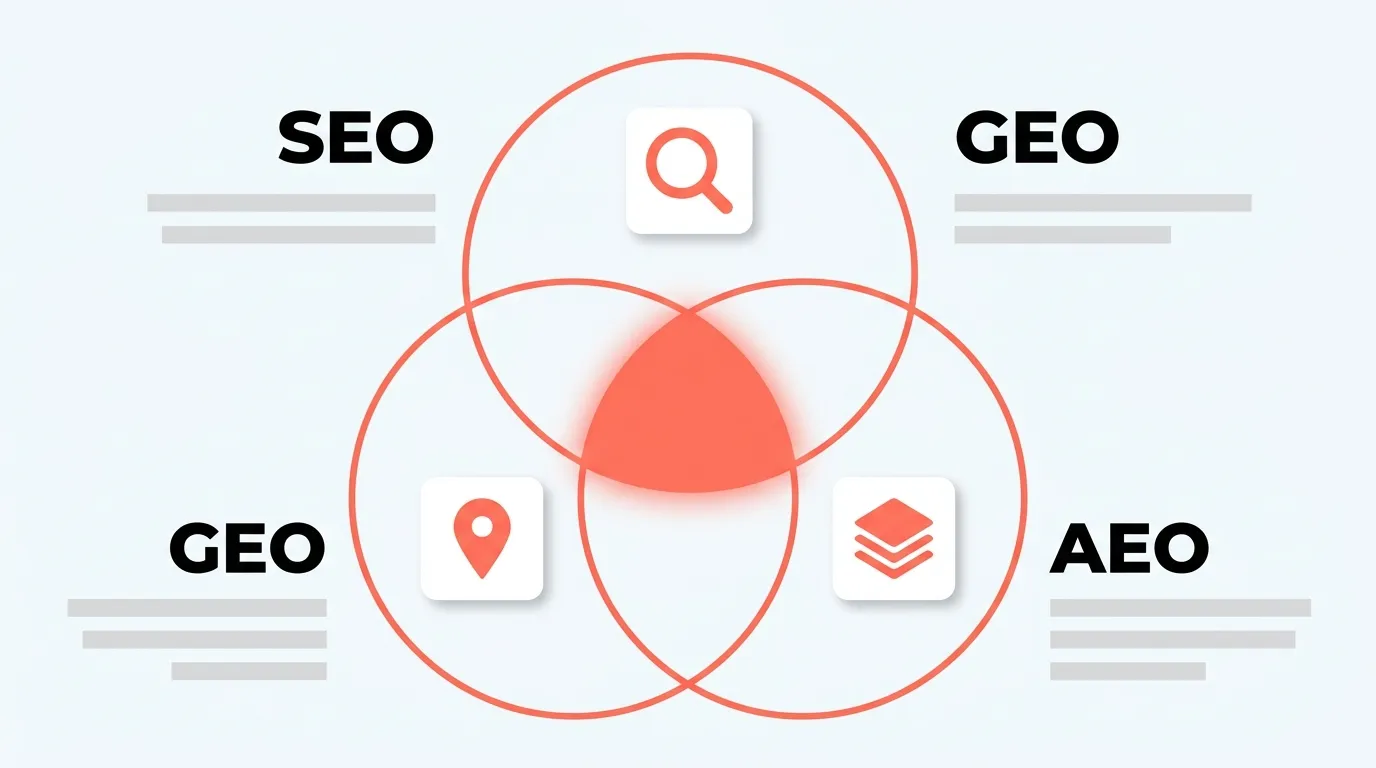
In practice, you rarely do just one. The technical and content work that makes a page rankable, clear structure, real expertise, fast and crawlable, is largely the same work that makes it citable by an AI system. A page with no SEO foundation (unindexed, thin, unauthoritative) has no chance at GEO or AEO either. The systems doing the citing still have to find and trust the page first.
What’s different is the extra layer AEO and GEO add on top: writing in a way a model can extract cleanly, being mentioned accurately across the web (not just linked to), and making sure your content answers the question directly instead of implying the answer somewhere in paragraph six. See the AEO guide for the full mechanics of how AI systems retrieve and choose citations.
Do you need all three?
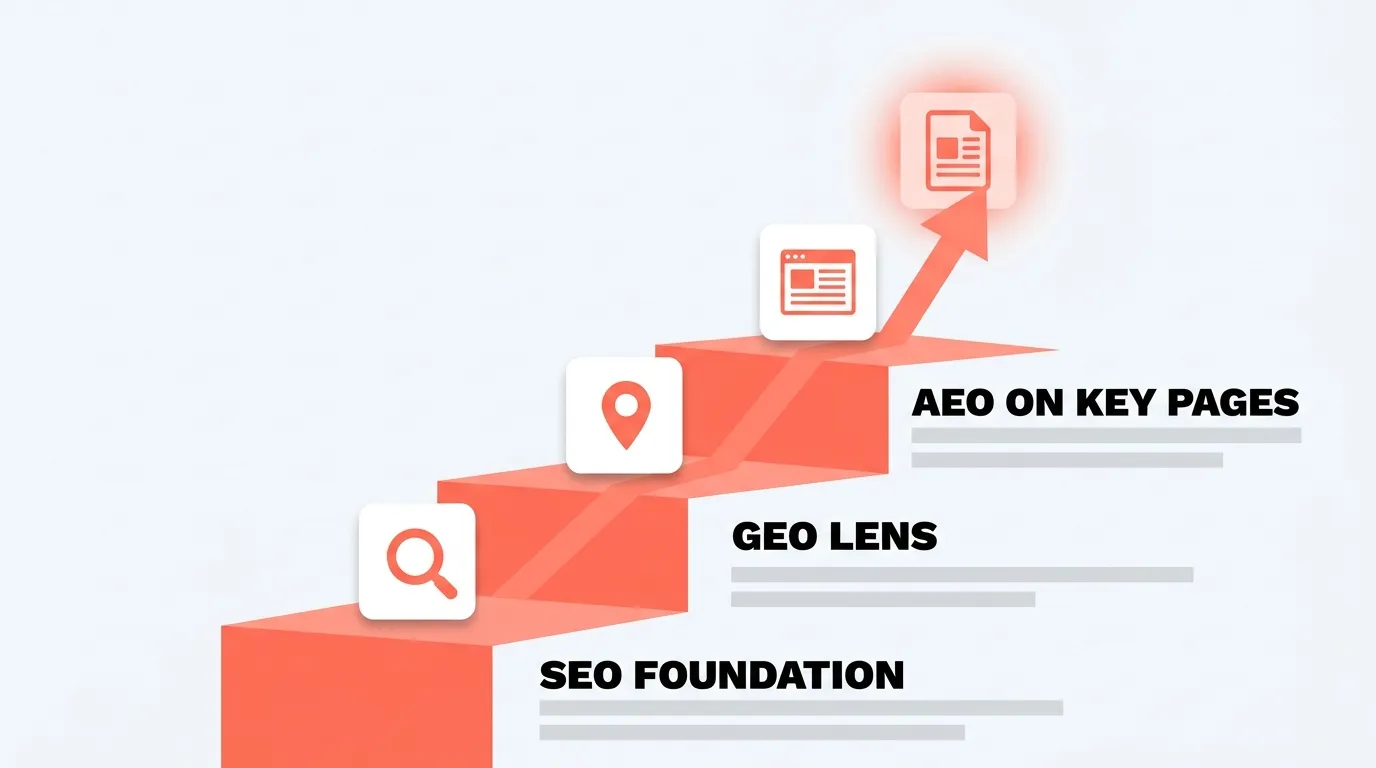
Yes, but not as three separate projects. If you’re already doing SEO, you don’t stop. GEO is the lens you start viewing that same work through: is this content something a model could represent accurately, not just something Google could rank. AEO is a specific tactic you apply on pages where getting cited directly, not just ranked, is the actual goal: definitional content, comparisons, and anything answering a discrete question. This page is a good example of exactly that.
Frequently asked
Is GEO replacing SEO?
No. GEO adds a layer on top of SEO fundamentals, it doesn't substitute for them. A page with no organic authority or technical health most likely won't get picked up by generative AI systems either.
Is AEO the same as GEO?
No, though they're used interchangeably. AEO is narrower: it's about winning the citation for one specific query. GEO is the broader discipline of how your brand is represented across generative AI systems as a whole.
Which one should I focus on first?
SEO fundamentals first, always, since GEO and AEO are built on top of them. From there, apply AEO tactics to any page whose whole purpose is answering one clear question.